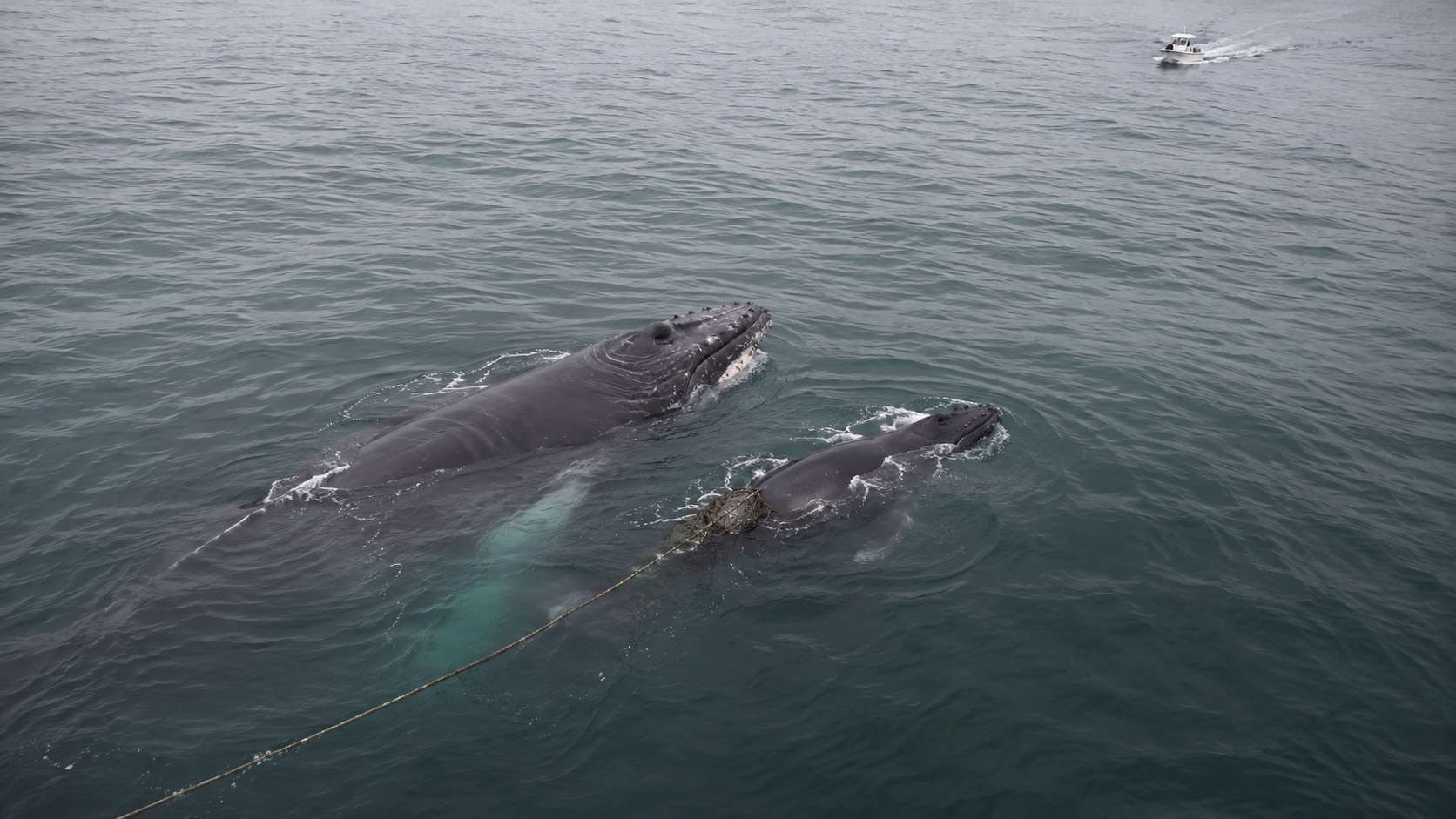
The young humpback pushed toward the surface, but the dark mesh tightened around its body.
Each movement produced the same cruel result. The calf gained a little water, lifted its head and tried to move forward. Then the net pulled tight again and stopped it.
Its mother stayed beside it.
She could have moved into open water. Instead, the adult whale slowed down, turned toward the struggling calf and remained dangerously close to the same equipment that had trapped it.
From above, the scene looked almost impossible to watch.
The calf needed to reach the surface to breathe. Meanwhile, its mother kept moving around it, trying to remain close as the net shifted through the water.
Then the danger changed.
The mother entered the entanglement too.
Help had not yet reached them, daylight was fading, and no one watching from shore knew whether both whales would survive the night.
The accompanying Reel is a modern visual reconstruction inspired by a documented humpback-whale entanglement. It is not the original drone footage and does not reproduce every movement in the exact order in which it occurred.
A Drone Found Them Far from Shore
The real incident unfolded off Noosa on Queensland’s Sunshine Coast on September 17, 2025.
Late that afternoon, drone operator Geoff Aquino received a call about whales in trouble near Noosa National Park. He reached the area, launched his drone and sent it hundreds of metres from shore.
What appeared on his screen was not a normal mother-and-calf migration.
Dark shark-control netting surrounded the whales. The calf struggled near the surface, while its mother fought inside the same dangerous area.
Aquino had spent years filming whales and other marine animals. Even with that experience, he described the situation as the worst entanglement he had witnessed.
Through the drone, he could see the young whale trying to breathe beneath a heavy amount of netting. The mother remained caught nearby and continued struggling around her calf.
At that moment, the outcome remained completely uncertain.
The Mother Did Not Leave
A humpback calf depends heavily on its mother during its first migration.
It must learn when to rise, where to travel and how to conserve energy over long distances. The mother also provides milk while guiding the calf through unfamiliar water.
A net changes every part of that relationship.
The calf cannot simply swim around an obstacle when mesh or rope tightens around its body. Each attempt to escape can pull the equipment harder, restrict movement and consume more energy.
For a young whale, that energy loss can become critical.
The mother faces a different choice. She may remain nearby, even when approaching the calf exposes her to the same ropes.
That appears to be what happened at Noosa.
Marine researcher Dr Olaf Meynecke examined the footage and said it showed the distressed adult rolling into the net and entangling the calf further. The exact sequence differed from the simplified reconstruction in the Reel, but the central reality remained the same: the mother stayed so close to her calf that both whales ended up in danger.
She did not abandon the young whale and continue south.
Instead, she remained inside the crisis.
Why the Surface Mattered So Much
Whales breathe air, so an entanglement becomes especially dangerous when it restricts their ability to rise.
A free humpback controls every breath. It can change direction, adjust its depth and surface when necessary.
The trapped calf had lost much of that control.
If the net held its body too low or limited its forward movement, exhaustion could make each new breath harder to reach. Rough water would add another challenge by pushing against both the calf and the floating equipment.
The mother’s presence could offer some protection. By staying close, she might help the calf maintain direction, reduce panic or keep it near the surface.
However, she could not simply lift a large calf out of the net.
Her movements also carried risk. A turn of the body could shift the mesh, tighten a line or pull the calf into a worse position. As the adult moved around the equipment, the same net could catch her flippers, body or tail.
Soon, the rescue involved two powerful animals rather than one.
That made every decision more difficult.
The Net Was Not a Wall Across the Beach
Many people imagine a shark net as a complete underwater fence that separates swimmers from sharks.
It does not work that way.
Queensland’s shark-control nets cover only selected areas of water. Sharks and other marine animals can move around, above or beneath them. The equipment aims to catch sharks passing through an area rather than create a sealed barrier.
At the time of the incident, Queensland’s program used 27 mesh nets at 21 beaches alongside hundreds of traditional drumlines. The state’s 2025–2029 management plan continued using these methods while also supporting research, monitoring and trials of newer technology.
The Queensland government says the program aims to reduce the risk of shark attacks at popular beaches.
Critics argue that nets also expose migrating whales, dolphins, turtles and other animals to unnecessary danger.
The debate becomes especially intense during humpback migration season.
Mothers and calves often travel close to the coast as they head south from warmer breeding waters toward feeding grounds in the Southern Ocean. Young whales lack the experience of adults and may not recognize netting until they enter it.
Once a calf becomes caught, its mother may refuse to leave.
Time Was Running Out
By the time the drone recorded the Noosa whales, the afternoon had already begun moving toward evening.
Darkness creates serious problems during a whale disentanglement.
Rescuers must work near animals that can weigh many tonnes. Even an exhausted whale can produce tremendous force with one movement of its tail.
At the same time, loose lines can wrap around a boat, propeller or rescuer. Waves may hide submerged netting, while poor visibility makes it harder to understand how the equipment crosses the animal’s body.
A team cannot simply approach with a knife and start cutting.
Rescuers first need to assess the whale’s position, the net’s tension, the movement of the sea and the safest point of approach. Cutting the wrong section can release stored tension, tighten another line or allow heavy equipment to pull across the whale.
The presence of a mother and calf complicates that work further.
Both animals may move differently. One could react when the other surfaces, dives or feels the net shift. A boat that approaches the calf may also draw a defensive response from its mother.
Nevertheless, waiting carries its own danger.
The calf had already spent valuable energy fighting the mesh. If it weakened too much, it might no longer reach the surface.
As the light disappeared over Noosa, the rescue team had to decide whether it could safely continue.
The Operation Continued in Darkness
Authorities did not leave the whales trapped until morning.
A contractor from Queensland’s Shark Control Program reached the location and carried out a nighttime release operation.
Working after dark increased the difficulty, but the calf’s condition gave the team little room to delay. Reports described the young whale as facing a serious risk of drowning.
Hour by hour, people waiting for news knew only that the mother and calf remained offshore with rescuers attempting to free them.
No public video showed a simple, dramatic moment in which one cut released both animals.
Real disentanglements rarely unfold that cleanly.
Crews must work through sections of rope and mesh while monitoring the whales’ breathing, movement and reactions. The team also needs to avoid leaving equipment wrapped around a fin, tail or body.
Eventually, confirmation arrived.
The mother and calf had come free.
Queensland’s Department of Primary Industries said the contractor successfully released both humpbacks during the overnight operation. The department also reminded the public never to approach or attempt to free whales without specialist training and equipment.
For the first time since the drone found them, the pair had a path back into open water.
But the Rescue Left One Worrying Question
Official reports confirmed the release, but not every observer believed all the danger had disappeared.
Meynecke later said the mother appeared to carry some gear after leaving the main net.
Humane World for Animals Australia also reported that the pair may still have retained pieces of netting after the operation.
A small amount of trailing material may sound less dangerous than a full net.
However, even one remaining line can create problems.
It may cut into skin, increase drag or snag other floating equipment. Long-term entanglement can also force a whale to spend additional energy during migration.
For a mother already supporting a calf, every unnecessary energy cost matters.
Researchers could not follow the whales continuously after they left the area. Therefore, the release ended the immediate emergency without answering every question about their condition.
Had the mother escaped with all the net removed?
Did the calf suffer injuries that the drone could not reveal?
Could both whales still complete the long journey toward southern feeding grounds?
The ocean closed around them before observers received those answers.
This Was Not an Isolated Accident
The Noosa incident became even more disturbing because another mother and calf had encountered shark-control equipment only days earlier.
That pair became entangled near Rainbow Beach and reportedly dragged netting over a long distance toward Hervey Bay.
For a period, four humpbacks from two mother-and-calf pairs faced entanglement at the same time. Meynecke said he had not previously seen four whales caught simultaneously in Queensland shark nets.
The pattern highlighted a recurring vulnerability.
Adult humpbacks may recognize some coastal dangers. Calves have much less experience.
A young whale can enter mesh without understanding the threat. Its mother then stays close, circles back or enters the equipment while trying to maintain contact.
The same bond that protects the calf during migration can place the adult in danger too.
Marine scientist Dr Vanessa Pirotta explained that trapped calves face stress and a risk of drowning, particularly when the equipment prevents normal movement.
Every entanglement develops differently. Still, one principle remains constant: the faster trained responders receive a report, the greater the chance that they can reach the animal before exhaustion becomes fatal.
Why Ordinary People Should Not Attempt the Rescue
Watching a whale struggle can create an overwhelming urge to help.
Approaching without training, however, may make the situation worse.
A person in a small boat cannot easily see how lines cross beneath the surface. Moving too close may frighten the whale, tighten the net or place the boat inside loose rope.
Entering the water creates even greater danger.
A single movement from the whale could strike a swimmer. Meanwhile, a submerged line could catch a leg or arm and pull the person beneath the surface.
Queensland authorities ask witnesses to report entangled animals through the Shark Control Program hotline and allow trained teams to respond.
The best first action is not to touch the net.
It is to provide an accurate location, describe the animal’s condition and continue observing from a safe distance when authorities request it.
Quick reporting helped bring attention to the Noosa pair before darkness fully closed over the coast.
What the Reel Shows—and What It Changes
The generated video presents the calf becoming trapped first while its mother approaches, remains beside it and begins entering the same danger.
That sequence creates a clear 15-second visual story.
The real drone footage appeared more chaotic. According to Meynecke’s interpretation, the stressed mother rolled into the equipment and wrapped the calf further in the net.
Therefore, viewers should treat the Reel as a visual reconstruction of the documented danger, not a frame-by-frame reproduction of the original event.
Several essential parts remain true.
A humpback mother and calf became trapped together off Noosa.
The calf struggled near the surface.
Its mother remained beside it.
Darkness approached before the rescue began.
Specialists worked overnight to release them.
Those facts provide more than enough tragedy without pretending that every generated movement came directly from the original footage.
She Could Have Left Alone
No one can know exactly what the mother understood while she remained inside the net.
She may have responded to the calf’s movements, breathing or calls. Maternal instinct may have kept her close even as the equipment threatened her own freedom.
Whatever the internal reason, her behavior created the defining image of the incident.
The adult whale had the strength to travel through open water.
Instead, she stayed beside the smaller body struggling at the surface.
That choice did not untangle the calf.
It could not cut the net or summon the rescue crew.
In fact, remaining close placed the mother in greater danger.
Yet she did not continue the migration alone.
By the time darkness covered the sea, both whales needed help.
Hours later, trained responders finally opened a path through the net. The mother and calf disappeared back into the ocean together, possibly still carrying marks—or even fragments—from what had happened.
The rescue ended the immediate struggle.
One image remained.
A calf could no longer move freely.
Its mother could.
But she refused to leave.
