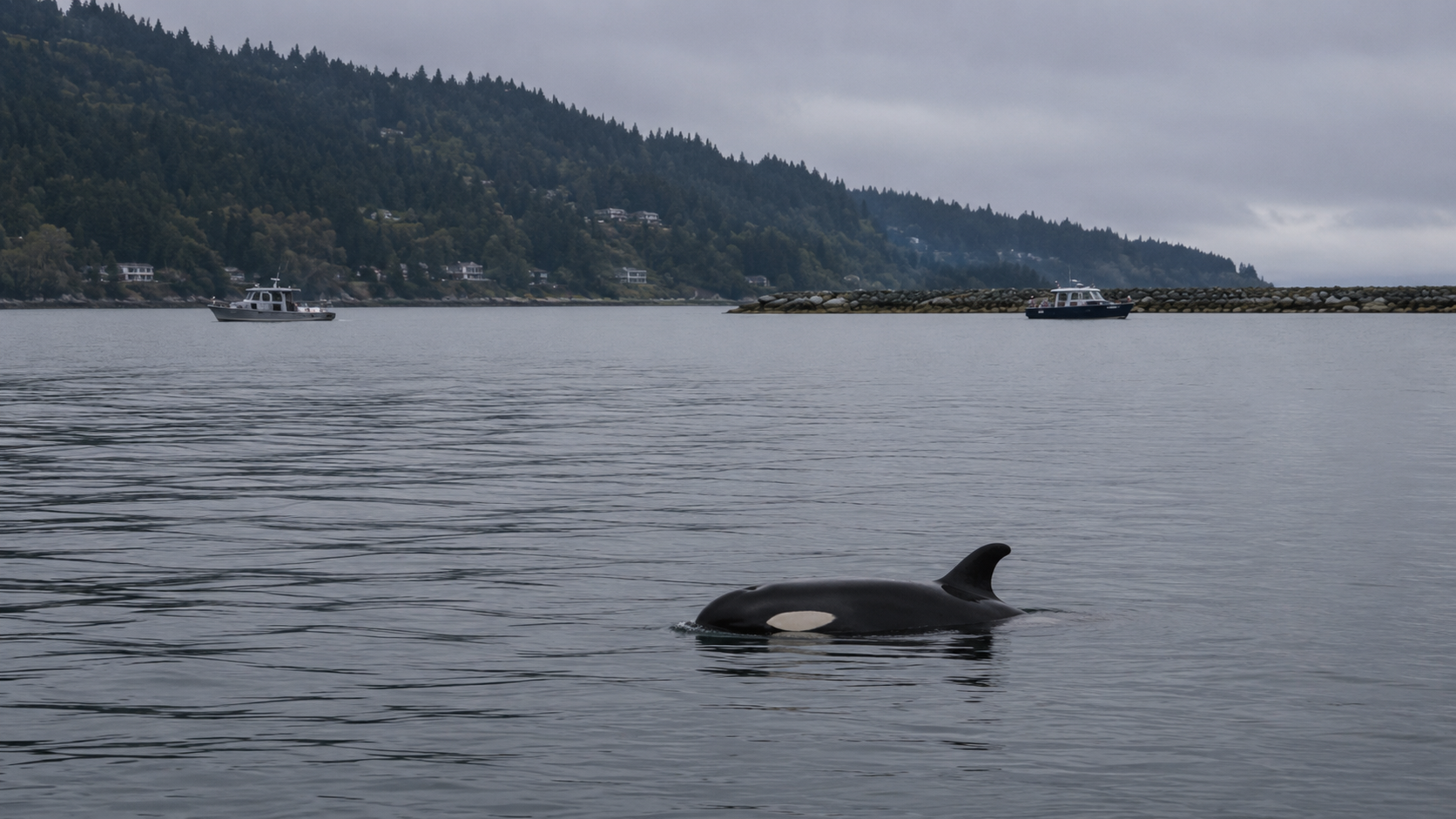
When people first saw her, she was alone.
A young orca was swimming in the cold grey waters of Puget Sound, far from where she should have been. There was no mother beside her. No pod around her. No familiar calls echoing through the water. Just a small black-and-white body moving through a place that suddenly felt much too big.
To anyone watching from shore or from a boat, she looked beautiful.
But to the people who understood orcas, something was terribly wrong.
Young killer whales are not meant to live alone. They are born into families, raised inside tight social groups, and guided by mothers, grandmothers, aunts, siblings, and pod members. In the wild, an orca calf does not just swim next to its family — it learns from them. It learns where to travel, what to eat, how to communicate, and how to survive.
This young orca had none of that around her.
Her name was Springer.
Scientists knew her as A73, a juvenile Northern Resident killer whale. On January 14, 2002, she was observed alone in Washington State’s Puget Sound near Seattle — far from her family’s home range in British Columbia waters. NOAA later documented her case as one of the most remarkable rescue stories in modern marine conservation.
At first, the situation was confusing. A young orca alone in busy waters was alarming enough, but Springer’s condition made everything more urgent. She was not simply separated from her pod; she was struggling. Reports from the rescue history describe her as orphaned, sick, and far from home. Ocean Wise later wrote that Springer was found about 500 kilometers from home, orphaned, starving, and sick in Puget Sound.
That made her case different.
This was not just a whale sighting.
It was a rescue problem.
Springer was young enough to need family, but old enough to travel. She was wild, but alone. She needed help, but humans could not simply treat her like a pet. Any wrong step could make things worse. If she became too comfortable around boats or people, her chances of surviving in the wild could drop even lower.
That was one of the biggest dangers.
During April and May of 2002, NOAA noted that Springer had become increasingly interested in people and boats. That behavior threatened her future success in the wild, especially because she was in a busy shipping lane and also needed medical care.
So rescuers faced a question that sounded almost impossible:
Could a lost orphan orca be treated, moved, and returned to her family without turning her into a captive animal?
It had never been done this way before.
On May 24, 2002, NOAA Fisheries announced that it would attempt to rescue Springer. A team was formed with experienced experts, along with partners from Washington State, Canada, the Vancouver Aquarium, and public-interest groups. Seven conservation organizations also created the Orphan Orca Fund to support the rescue effort.
The challenge was enormous.
They had to protect her from boats. They had to monitor her health. They had to treat her medical problems. They had to keep her from becoming attached to humans. And somehow, they had to move her from Puget Sound back toward the waters where her family still traveled.
The rescue took place on June 13, 2002.
Springer was moved safely to a floating net pen on Washington State’s Kitsap Peninsula. At that time, she weighed 1,240 pounds and measured 11 feet long. Veterinarians examined her, tested her, and began treatment.
For a month, Springer was rehabilitated in the net pen.
But this was not like keeping her in an aquarium.
The team had to be extremely careful. They needed to feed her and treat her, but they also needed her to remain wild. NOAA’s account explains that remote video monitoring helped staff observe her behavior from a distance. They watched her feeding on live salmon placed in the pen, while avoiding the dangerous lesson that food came from humans.
That detail matters.
For Springer to go home, she had to stay an orca — not become dependent on people.
Slowly, she improved. Her ketosis disappeared, her skin improved, and she was treated for worms. She gained 112 pounds during rehabilitation, reaching about 1,350 pounds before her transport north.
But the rescue was only half the story.
The bigger question still waited in the water:
Would her family accept her again?
On July 13, 2002, Springer was loaded onto a transport vessel and taken up the coast toward Johnstone Strait, between Vancouver Island and mainland British Columbia. She was brought to Dong Chong Bay on Hanson Island and placed into another net pen to recover from the trip.
Then something happened that rescuers would never forget.
On July 14, whales from her pod were in the area near the net pen, and Springer responded excitedly. The moment told the experts what they needed to know. Officials from the Vancouver Aquarium and Canada’s Department of Fisheries and Oceans decided it was time.
At about 2:45 p.m. Pacific time, the gate of the net pen was raised.
Springer swam free.
After months of uncertainty, the orphan orca was back in the waters of her family.
It sounds simple when told in one sentence. But nothing about it was simple. Springer’s return was the result of science, patience, international cooperation, and an unusual decision to try something that had almost no precedent.
NOAA later described Springer as the first killer whale calf to be rescued, rehabilitated, and released, and noted that she was reunited with her family in British Columbia in July 2002.
That is what makes her story so rare.
Many wildlife rescue stories end with tragedy. Some animals are too sick. Some are too young. Some become too habituated to people. Some cannot be returned to the wild. With large marine mammals, the obstacles are even greater.
But Springer made it.
And the proof came not only on the day she was released, but in the years that followed.
In July 2003, Springer returned with her pod. From 2004 through 2012, she was sighted again with her pod and appeared healthy and active. NOAA’s chronology continued to track her over the years, showing that the rescue did not just work for one day — it worked for a lifetime.
Then the story became even more powerful.
Springer became a mother.
In 2013, she was seen off British Columbia’s central coast with her first calf, Spirit. Later, she had a second calf named Storm. NOAA reported in 2022 that Springer had been photographed off British Columbia with both of her calves and that they appeared to be doing well.
That changes how her rescue feels.
Saving Springer did not only save one orphaned calf.
It allowed her to return to her community, grow up in the wild, and raise calves of her own. Her rescue became part of the future of her family line.
Twenty years after the rescue, Ocean Wise wrote that Springer was thriving with two calves, Spirit and Storm, often seen on the north central British Columbia coast and returning to Johnstone Strait most summers.
That is why her story still matters.
Springer proved that rescue does not always mean captivity. She proved that helping a wild animal can mean doing everything possible to return it to the wild, even when the path is difficult. She also proved that cooperation between governments, scientists, conservation groups, veterinarians, local communities, and the public can change the ending of a story that once looked hopeless.
Her case also taught rescuers lessons for the future. NOAA’s Brad Hanson later said that the techniques and expertise developed during Springer’s rescue helped inform responses to other ailing whales, even when later cases did not end as successfully.
That is the quiet power of Springer’s story.
It is not dramatic because something terrible happened.
It is dramatic because something good almost did not.
A young orca was alone in the wrong water. She was sick, far from home, and becoming too interested in humans and boats. Every day mattered. Every decision carried risk. If rescuers waited too long, she might not survive. If they intervened poorly, she might never live wild again.
But they found a way.
They treated her without turning her tame. They moved her without making her captive. They returned her to the waters where her family still swam.
And when the gate opened, she did what everyone had hoped she would do.
She went home.
For many people, orca stories are filled with loss — capture, tanks, separation, and animals that never see their families again. Springer’s story is different. It does not erase the pain in other stories, but it gives something rare: proof that sometimes, when humans act carefully and humbly, they can help repair what looked broken.
Springer was not a symbol of captivity.
She became a symbol of return.
A reminder that wild animals do not need us to own them.
Sometimes, they only need us to give them the chance to be wild again.
And somewhere in the cold waters of British Columbia, the orphan calf who once swam alone has been seen traveling with her own calves.
That is the ending people hoped for.
Not a show. Not a tank. Not a life behind glass.
Just an orca, back with her family, moving through the water where she always belonged.
