The Tank Was Never the Ocean
He was built for open water.
For distance.
For sound.
For the kind of movement that belongs to an animal born into one of the most powerful families in the sea.
But for most of the world, Tilikum was never seen in the ocean.
He was seen inside a tank.
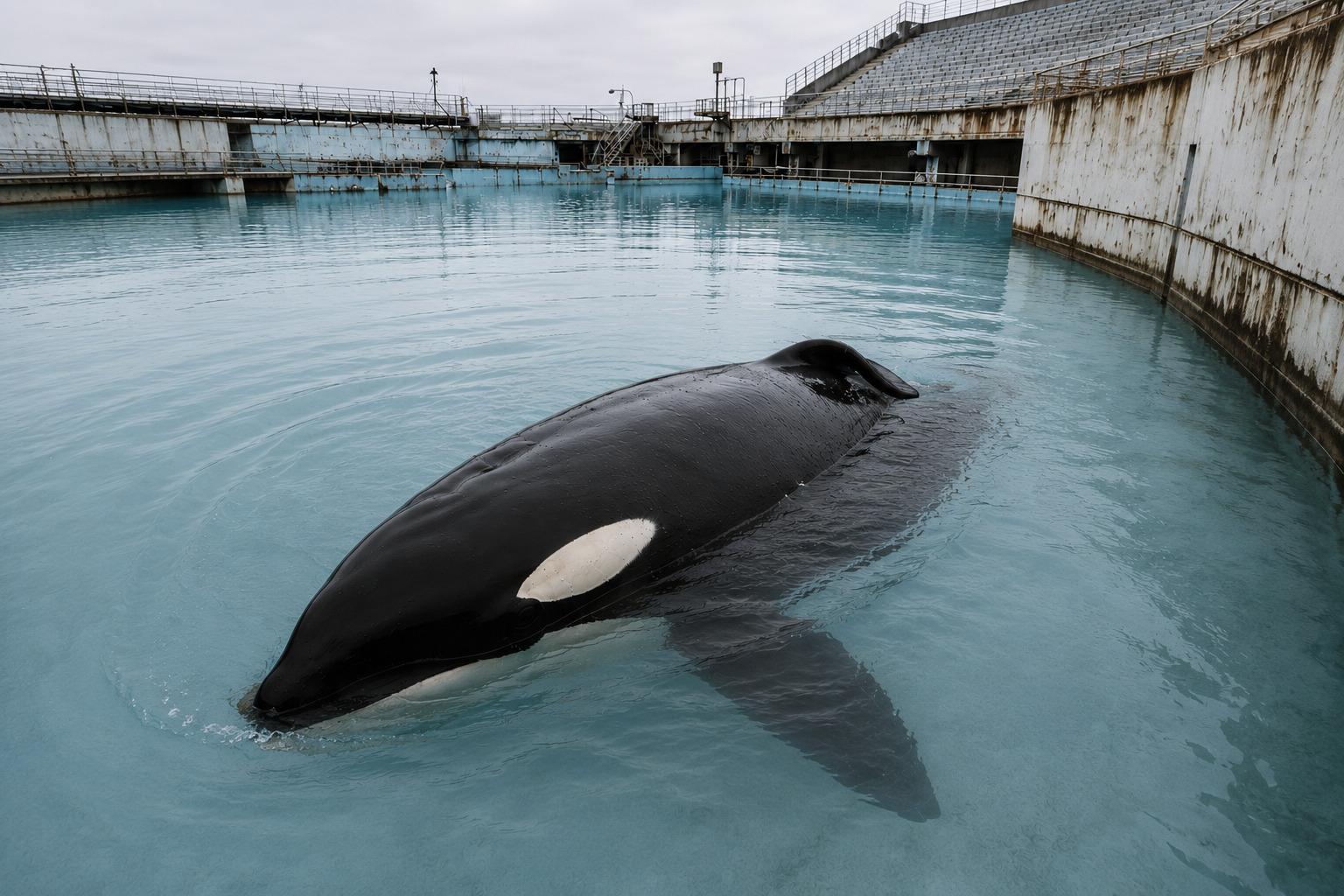
Pale blue water. Concrete walls. Metal railings. Human-made edges. A space designed not by whales, but by people.
And that contrast is what made his story so difficult to forget.
Because no matter how blue the water looked, no matter how carefully the facility was maintained, no matter how many people came to watch him, the tank was never the ocean.
A Whale Made for a World Without Walls
Tilikum was a male orca, one of the ocean’s most intelligent and socially complex predators. Orcas are not simple animals moving alone through water. They live in social groups, communicate with sound, learn from one another, and build their lives around relationships that can last for decades.
NOAA describes killer whales as highly social animals, with most living in pods made up of maternally related individuals.
That matters when we talk about Tilikum.
Because an orca is not only a body.
It is a voice in a family.
A memory inside a group.
A creature shaped by movement, sound, depth, and connection.
In the wild, an orca’s world is not a square of water with a wall at the end. It is a changing world of currents, calls, hunting routes, social bonds, and space. The ocean is not just where an orca lives. It is part of what an orca is.
That is why captivity has always raised such painful questions.
A tank can hold water.
But can it hold a life?
The Artificial Blue
People often remember the color first.
The bright artificial blue of the marine park pool.
From a distance, it can almost look peaceful. Clean water. Smooth surface. A huge black-and-white animal moving slowly beneath the light.
But the image changes when you stop seeing the water as “blue” and start seeing the walls around it.
The corners.
The concrete.
The same route repeated again and again.
For a whale like Tilikum, the tank did not offer the endless distance of the ocean. It offered boundaries. It offered a surface and a bottom. It offered a place where every movement eventually met a wall.
That is the emotional center of his story.
The tank was not empty.
But it was limited.
It was not dry.
But it was not the sea.
It could keep a whale alive, but it could not become the world that shaped his species.
What the Ocean Gives an Orca
The ocean gives an orca more than space.
It gives sound.
It gives distance for calls to travel.
It gives social structure, hunting, choices, movement, depth, and constant change.
Wild orcas use sound to communicate, coordinate, and stay connected. They are built for acoustic worlds that humans can barely imagine. Their calls move through water in ways we cannot experience from land.
A tank changes that.
Concrete reflects sound. Walls create limits. The environment becomes smaller not only in distance, but in sensation. For an animal that relies so heavily on sound, the difference between open water and a concrete enclosure is not just visual.
It is physical.
It is social.
It is sensory.
And it is emotional for the people who look at Tilikum’s life and ask what it must have meant for a whale to spend year after year in a world so much smaller than the one he was born for.
Tilikum’s Captive Life
Tilikum was captured in Icelandic waters in 1983. After time at Sealand of the Pacific in Canada, he was transferred to SeaWorld Orlando in 1992, where he became one of the most famous captive orcas in the world.
To millions of visitors, he was a performer.
To the public debate that came later, he became a symbol.
But before either of those things, he was a young orca taken from the ocean and placed into human control.
That is the part of the story that cannot be separated from the tanks he lived in.
Captivity did not simply change where he was.
It changed what his life could be.
His daily world became a contained space. His movement became managed. His relationships became determined by human decisions. His body remained enormous, powerful, and ocean-made — but his environment became artificial.
That contradiction stayed with him for the rest of his life.
Why the Walls Matter
It is easy to talk about captivity in abstract words.
Animal welfare.
Public education.
Entertainment.
Conservation.
But sometimes one image says more than all of those words.
Tilikum’s huge body moving through a tank.
His collapsed dorsal fin above artificial blue water.
Concrete walls close enough to define the limits of his world.
That image made people feel something before they could explain it.
The walls mattered because they showed the difference between what an orca is and what humans had made him live inside.
A tank can be large by human standards.
It can look impressive to visitors.
It can be managed by professional staff.
But an orca does not belong to human standards of space. An orca belongs to ocean standards.
That is the scale people began to think about when Tilikum’s story reached the world.
Not just the size of the animal.
The size of the life he was missing.
The Story the Tank Told
Tilikum’s story was never only about one whale in one facility.
It became part of a larger conversation about whether animals as intelligent, social, and powerful as orcas should be kept in environments built for display.
The documentary Blackfish, released in 2013, brought that conversation to a much wider audience by focusing on Tilikum and the controversy surrounding captive orcas.
People argued.
People defended SeaWorld.
People criticized it.
Some saw Tilikum’s life as proof that captivity was harmful. Others believed marine parks provided care, education, and a connection to wildlife that people might not otherwise have.
But even across those disagreements, one image remained difficult to avoid:
A whale born for open water, living inside concrete.
That image did not need to shout.
It simply stayed in people’s minds.
A Body the Tank Could Hold
The most painful truth may be this:
The tank could hold Tilikum’s body.
But it could never hold everything he was.
It could not hold the distances his species travels.
It could not hold the family structures that shape orca lives.
It could not hold the deep acoustic world of the sea.
It could not hold the changing currents, the cold water, the social choices, the natural rhythms, or the open space that define an orca’s existence.
It could hold a whale.
But not a whale’s world.
That is why people still react so strongly to images of captive orcas. The sadness is not only in the animal’s face or fin or movement. It is in the mismatch between the creature and the place.
A huge ocean animal.
A limited artificial pool.
A life made smaller than it should have been.
The Change That Followed
Tilikum’s life became one of the central stories in the public shift around captive orcas. In 2016, SeaWorld announced that the orcas in its care would be the company’s last generation and that it would end its orca breeding program.
SeaWorld has also stated that its orcas are the last generation at its parks and that its goal is to inspire guests to protect wildlife and the environment.
For many people, that change showed how much the conversation had moved.
Tilikum did not live to see the end of the debate.
But his life helped force the debate into the open.
He became part of a turning point — not because his story was simple, but because it was impossible to ignore.
The Tank Was Never the Ocean
There is a reason this chapter of Tilikum’s life still hurts.
It is not only because of the controversy.
It is not only because of the headlines.
It is because the visual truth was so clear.
He was a giant animal in a confined world.
A whale whose life had been separated from the environment his species evolved to know.
When people looked at Tilikum, they saw more than a captive orca. They saw a question humans had avoided for too long:
Can we admire an animal while denying it the world that made it?
For Tilikum, the answer came through a lifetime of concrete walls and artificial water.
The pool could reflect the sky.
It could shine blue under the lights.
It could make people believe they were seeing something close to the ocean.
But it was never the ocean.
And Tilikum was never just a whale in a tank.
He was a reminder of what can be lost when the ocean is replaced by walls.
