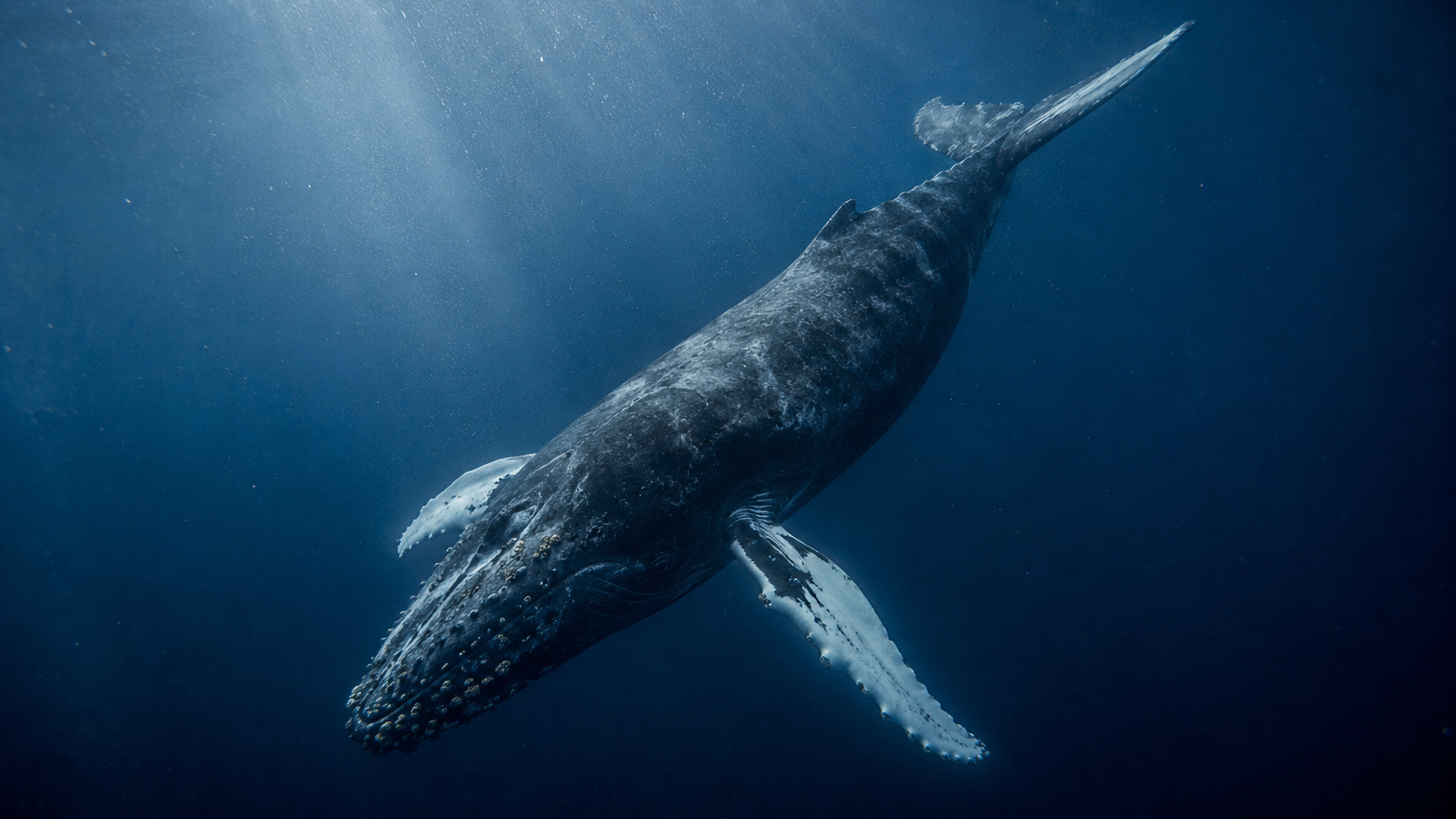
The death of a great whale looks like an ending. But miles below the surface, in the cold and the dark, it is something else entirely — the beginning of one of the strangest, richest, and most beautiful worlds in all the ocean.
When an old whale finally dies, her enormous body begins to sink.
Slowly, gently, she falls — down through the sunlit blue, through the fading light, into a darkness where the sun has never reached. Her body may descend more than a mile, to a place so cold and so empty that for centuries people assumed almost nothing could live there at all.
And then something extraordinary happens. Her death becomes the beginning of life on a scale that is hard to imagine.
A feast in an underwater desert
To understand why, you have to understand the deep seafloor.
It is, for the most part, a desert. Sunlight cannot reach it, so plants cannot grow. Food is desperately scarce. The animals that live down there often go months — sometimes years — between meals, surviving on the faint drizzle of “marine snow,” the tiny flakes of dead matter that drift down from the world far above.
So when a whale’s body lands on the seabed, it is not a tragedy to the creatures of the deep. It is a miracle. Tens of tons of food, arriving all at once, in a place that almost never sees a single proper meal.
Scientists have a name for this event: a whale fall.
[EMBED YOUR VIDEO HERE]
A discovery made by accident
For most of human history, no one even knew whale falls existed. How could they? They happen in total darkness, miles beneath the waves, in some of the least explored places on the planet.
That changed in 1987, when a research team led by marine biologist Craig Smith was exploring the deep seafloor off the coast of California in a submersible. By pure chance, they came across the skeleton of a whale resting on the bottom — and they were astonished by what they saw. The bones were not lifeless. They were crawling, blooming, teeming with creatures, many of which scientists had never seen before.
It was the first time anyone had witnessed a whale fall up close. And it opened the door to one of the most surprising discoveries in modern ocean science.
The world that builds itself
What happens to a whale fall unfolds in stages, and the whole process can last for decades.
First come the scavengers. Drawn by the scent carried on deep currents, sleeper sharks, hagfish, rattail fish, and crabs travel from miles away to feed. Over months, sometimes years, they strip away the soft tissue, and the area around the carcass becomes one of the busiest places in the deep ocean.
Then come the settlers. Once the big scavengers have had their fill, smaller creatures move in by the thousands — worms, snails, shrimp, and other tiny animals that colonize the bones and the nutrient-rich sediment that has soaked into the seabed around the body.
And finally come the specialists — the strangest residents of all. These are creatures that exist almost nowhere else on Earth except on the bones of dead whales. The most famous of them are the bone-eating worms of the genus Osedax, sometimes nicknamed “zombie worms.” These remarkable animals have no mouth and no stomach at all. Instead, they drill root-like structures into the whale’s skeleton and rely on special bacteria to dissolve the bone itself, unlocking the rich fats and oils stored deep inside.
A single whale skeleton can go on feeding these communities for up to fifty years.
One ending, a thousand beginnings
Stop and think about that for a moment.
The whale who fell into the dark does not simply vanish. Her body becomes an island of life in an empty desert. It feeds sharks and crabs and worms and bacteria. It shelters entire species that owe their existence to whales like her. For half a century — long after she is gone — life continues to bloom on what remains of her.
Scientists now believe that whale falls may even act as “stepping stones” across the deep ocean, allowing strange specialized creatures to spread from one fallen whale to the next across vast distances of empty seafloor. In other words, the deaths of whales may help knit the deep ocean together.
It is one of the most quietly beautiful ideas in all of nature: that the death of a single great life can give rise to thousands of others.
Why it matters more than ever
There is a sadder side to this story, too.
For most of the last few centuries, humans hunted great whales in staggering numbers, pushing many species to the very edge of extinction. We now know that this didn’t only cost the whales their lives — it may have starved the deep sea of these precious falls, and the unique creatures that depend on them.
As whale populations slowly recover, so too may this hidden cycle of death and rebirth that has been quietly shaping the deep ocean for millions of years.
She didn’t just live. And she didn’t just die.
She became a world.
If this gave you a new way of seeing the ocean, share it. The more people understand how deeply connected ocean life truly is, the more we’ll fight to protect the giants who hold it all together. Whales aren’t only magnificent while they’re alive — they go on giving life long after they’re gone.
