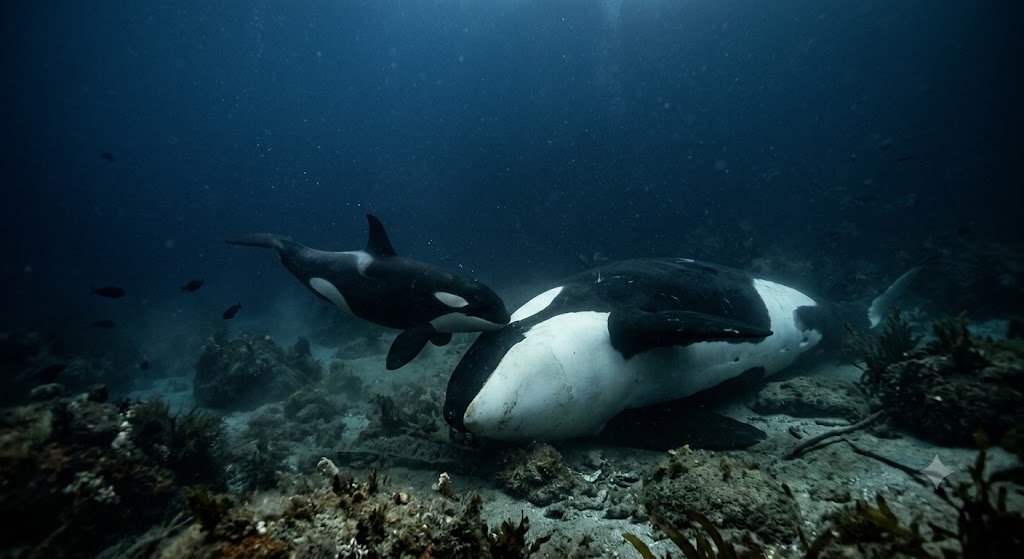
In the cold waters of the Pacific Northwest, scientists have witnessed something that shatters the old idea that grief belongs to humans alone. They have watched orca mothers carry their dead babies for days. And they have come to understand something even more heartbreaking: among orcas, the bond between a mother and her child is so powerful that when she dies, her children can be left in mortal danger — for the rest of their lives.
This is the story of the strongest family bond in the ocean, and the tragedy that hides inside it.
A Bond Unlike Almost Any Other
Orcas, or killer whales, are among the most family-oriented animals on Earth. In certain populations — like the endangered Southern Resident killer whales that swim off Seattle, Vancouver, and Victoria — the children never leave home.
This is extraordinarily rare in the animal kingdom. In most species, the young grow up and strike out on their own. But male orcas in these pods stay beside their mothers for their entire lives, often more than 50 years. Daughters stay close too, raising their own calves within the family group. The mother is the center of everything — her knowledge, her leadership, and her care hold the whole family together.
She even shares her food. Mothers have been seen breaking salmon in half to feed their grown sons, decades after they were born.
When the Mother Dies
Because that bond is so deep, its loss is devastating — and not only emotionally.
Scientists studying Southern Resident orcas made a sobering discovery. When a mother dies, her adult sons become far more likely to die in the following year. One major study found that an adult male orca’s risk of death jumped dramatically in the year after losing his mother. Without her — without her guidance to the best hunting grounds, her shared food, and her lifelong support — even a fully grown male can struggle to survive.
For a young calf, the danger is even greater. A newborn orca depends entirely on its mother for milk, for warmth, for protection, and for learning how to be an orca at all. A calf that loses its mother in its first months has little chance of surviving on its own.
This is why researchers who study these whales describe the mother-calf relationship as quite literally a lifeline. To lose her is to lose the very thing that keeps you alive.
A Family Already Fighting to Survive
The tragedy runs even deeper for the Southern Residents, because this tiny population is already on the edge of extinction. Only around 73 of these orcas remain in the world.
Their greatest threat is hunger. These orcas depend almost entirely on Chinook salmon — and the salmon have been disappearing, shrinking in both number and size due to dams, pollution, and overfishing. Where fishermen once caught 40-pound Chinook, the average is now closer to 12.
The result is heartbreaking. Studies have found that roughly two-thirds of Southern Resident pregnancies now fail, and about half of the calves that are born do not survive their first year. A hungry mother cannot always produce enough milk. A grieving family cannot always protect its youngest.
This is the same population that includes Tahlequah — the mother who made world headlines in 2018 when she carried her dead calf for 17 days across 1,000 miles, and who, heartbreakingly, was seen grieving another lost calf in early 2025.
Grief Beneath the Waves
For a long time, people assumed animals couldn’t truly mourn. But the more scientists watch orcas, the harder that belief is to hold.
Researchers have documented mothers refusing to let their dead babies sink, diving down again and again to lift the small bodies back to the surface. They have seen entire pods slow down and stay close to a grieving mother, as if keeping vigil with her. One scientist put it simply: we don’t have the market cornered on emotions. Why shouldn’t they feel grief, when they love so deeply?
As one researcher observed, the grieving process for these whales may not last days — it may last a lifetime, just as it does for us.
Why Their Story Matters
The bond between a mother orca and her child is a mirror held up to our own hearts. It shows us love, loyalty, and loss in a creature utterly unlike us, and yet achingly familiar.
Every lost calf is not just one small death. In a population of only 73, it is a step closer to losing these magnificent animals forever. But it is also a reminder of something worth protecting: a family so devoted that its children never leave their mother’s side, and a mother whose love quite literally keeps her children alive.
To know them, as one researcher said, is to love them. And perhaps loving them is the first step toward making sure their story does not end in silence.
