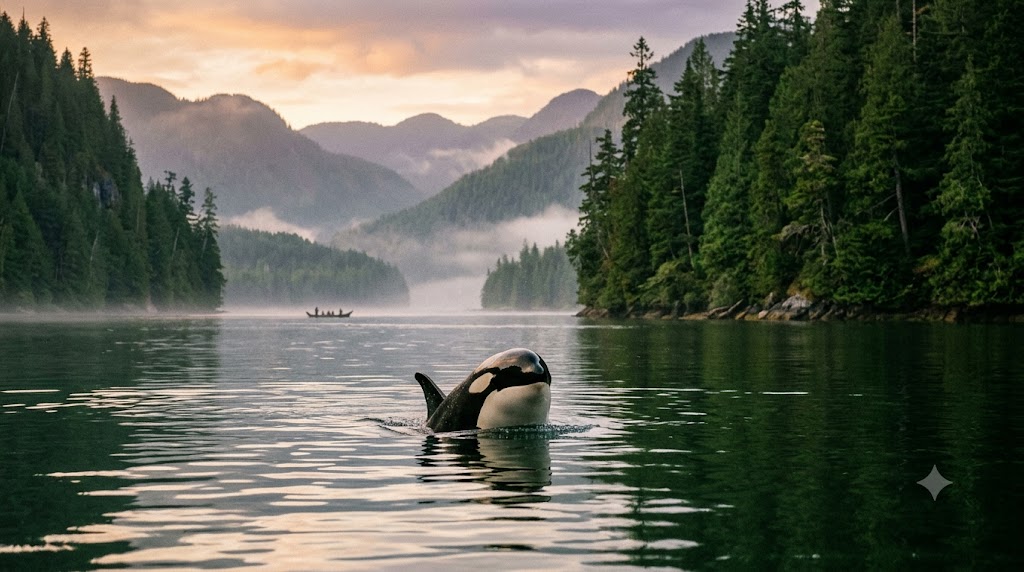
In the summer of 2001, a young killer whale appeared, all alone, in a remote fjord on the west coast of Vancouver Island, Canada. He was just a child in orca terms — separated from his family and hundreds of miles from where he belonged.
What followed was one of the most touching, and ultimately heartbreaking, true stories the ocean has ever given us. Because this little whale didn’t just survive his loneliness. He reached out across the divide between species, and tried to make friends with us.
His name was Luna.
A Child Lost at Sea
Luna was born in September 1999 into a Southern Resident orca family known as L pod. Scientists called him L98. Orcas are intensely social animals — they live their whole lives beside their mothers and relatives, and a young orca alone is something almost never seen in the wild.
But somehow, Luna became separated from his pod. Researchers believe he may have followed a dying older relative who fell behind the group, then lost track of his family entirely and drifted north into Nootka Sound, a quiet, forested inlet far from any other orcas.
There, against all odds, the little whale survived on his own. He learned to feed himself. He grew. But he was utterly, profoundly alone.
Reaching Out to Us
Orcas are not built for solitude. They need company the way we need air. And so Luna did something extraordinary — he made a pod out of the only company available to him: the people of Nootka Sound.
He began approaching boats and docks. He would surface beside fishing vessels, roll onto his side, and look up at the people aboard with what witnesses described as a soulful, searching gaze. He liked to have his tongue rubbed. When people whistled to him, he would squeak and whistle back. He even learned to mimic the bark of the local sea lions and the sound of boat engines.
To the people who met him, it was impossible not to fall in love. Here was a wild, intelligent, powerful creature who seemed to want nothing more than connection. Fishermen, locals, tourists, and the local First Nations community all developed a deep affection for him.
The Mowachaht-Muchalaht First Nation gave him a special meaning. Their chief, Ambrose Maquinna, had died days before Luna appeared — and before his death he had said he would return as an orca. Many believed Luna carried the spirit of their chief. They named him Tsu’xiit.
A Friendship Against the Law
But not everyone agreed that Luna’s friendships with humans were a good thing.
Marine biologists and the Canadian government grew worried. They feared that the more attached Luna became to people and boats, the less likely he would ever be to rejoin his real family — and the more danger he faced from propellers and busy traffic. So officials made a controversial decision: human contact with Luna was banned.
Under Canadian law, disturbing a marine mammal was illegal, and authorities ruled that playing with Luna counted as disturbance. People were warned, fined, and even charged for petting him. The maximum penalty was a staggering $100,000.
And so an aching paradox took shape. A desperately lonely whale kept swimming up to people, asking to be loved — while the law commanded those same people to turn away from him. Many couldn’t bear it. They kept sneaking out to see him anyway, described by one writer as carrying friendship through the dark like smugglers.
A Reunion That Never Came
There were plans to reunite Luna with his pod. In 2004, officials prepared to lure him toward his family or move him by truck closer to their waters. At one point, his relatives passed within about 60 miles of Nootka Sound — and hopes soared.
But the pod never came close enough. And when the government tried to capture him, members of the First Nation paddled out in traditional canoes to intercept the boats, leading Luna gently away with their songs, determined that their chief would not be taken. The capture was abandoned.
Year after year, Luna stayed in Nootka Sound. Still friendly. Still curious. Still alone.
The Heartbreaking End
On the morning of March 10, 2006, Luna approached a large tugboat called the General Jackson, a kind of vessel he had played with many times before. As he swam close, playing around it the way he always did, he drifted too near the boat’s powerful propeller.
He was killed instantly.
Luna was just six years old. He had lived more than four years alone in Nootka Sound — surviving, growing, and reaching out to anyone who would meet his eye.
His death was reported around the world. The people who had loved him, fought over him, and tried to protect him were left heartbroken. And many were haunted by the same painful question: had his love for boats — the very thing that kept him company in his loneliness — been the thing that cost him his life?
Why We Still Remember Luna
Luna’s story endures because it asks something difficult of us. He showed that the bond between humans and animals can be real, profound, and mutual. He reminded us that intelligence and the need for love are not ours alone — that a wild creature can look into our eyes and genuinely want to be seen.
We tried to do right by him, and in many ways we failed him. But Luna never stopped reaching out, never stopped trusting, never stopped wanting a friend.
A lonely whale who only ever asked for company taught millions of people what connection really means. And that is why, all these years later, the world has never forgotten the little orca named Luna.
