In January 2002, boaters in Puget Sound near Seattle spotted something that should not have been there: a tiny orca calf, all alone. She was barely two years old — in human terms, little more than a toddler — and she was hundreds of miles from where any orca like her should be.
She was thin. She was sick. And she had no family in sight.
What happened to that lonely little whale over the next six months would become one of the most hopeful stories in the history of ocean conservation — the only time in recorded history that a wild orca has been rescued and successfully returned to her family.
A Baby Alone in the Wrong Place
Orcas are among the most social animals on Earth. They live their entire lives in tight family groups called pods, staying with their mothers and relatives for decades. A young orca alone is almost unheard of — and almost always a death sentence.
This calf was different from the local Southern Resident orcas. Scientists were puzzled. Who was she? Where had she come from?
The answer came from her voice. Orca families have their own distinct dialects — unique calls passed down through generations. By recording her vocalizations and comparing photographs of the white patch near her eye, researchers made an astonishing identification: she was A73, a Northern Resident orca whose home waters lay some 300 miles to the north, off the top of Vancouver Island. People nicknamed her Springer.
Her mother had most likely died sometime in 2001, leaving the orphaned calf to drift hundreds of miles south, ending up lost and starving in the busy waters near Seattle.
A Decision Never Made Before
Springer’s health was failing. She had a skin condition, she was underweight, and her breath carried the smell of a body beginning to burn through its own fat reserves — a sign she wasn’t eating enough. Worse, she had begun approaching boats, putting herself in constant danger.
Experts faced a hard question: leave her to nature, or attempt something that had never been done? After months of heated public debate, the U.S. National Marine Fisheries Service, Canada’s Department of Fisheries and Oceans, and the Vancouver Aquarium made a historic decision. They would catch the orphan, nurse her back to health, and carry her home.
On June 12, 2002, Springer was gently lifted from the water and moved to a sea pen in Manchester, Washington. There, she was treated, fed, and watched around the clock. Slowly, she began to recover.
The Journey Home
A month later, the most delicate part of the plan began. On July 13, 2002, Springer was placed in a sling, lifted into a transport box aboard a high-speed catamaran, and carried on a ten-hour voyage north to Johnstone Strait, off northern Vancouver Island — the home waters of her family. First Nations communities welcomed her, and even caught live salmon to fill her new sea pen.
Then came the moment everyone had been waiting for. On the very night she arrived, members of her extended family swam past her pen. Springer heard them. According to those present, she suddenly became intensely excited — breaching and calling out loudly into the dark water.
The next day, the pen was opened. And Springer swam free.
Welcomed Back by Her Family
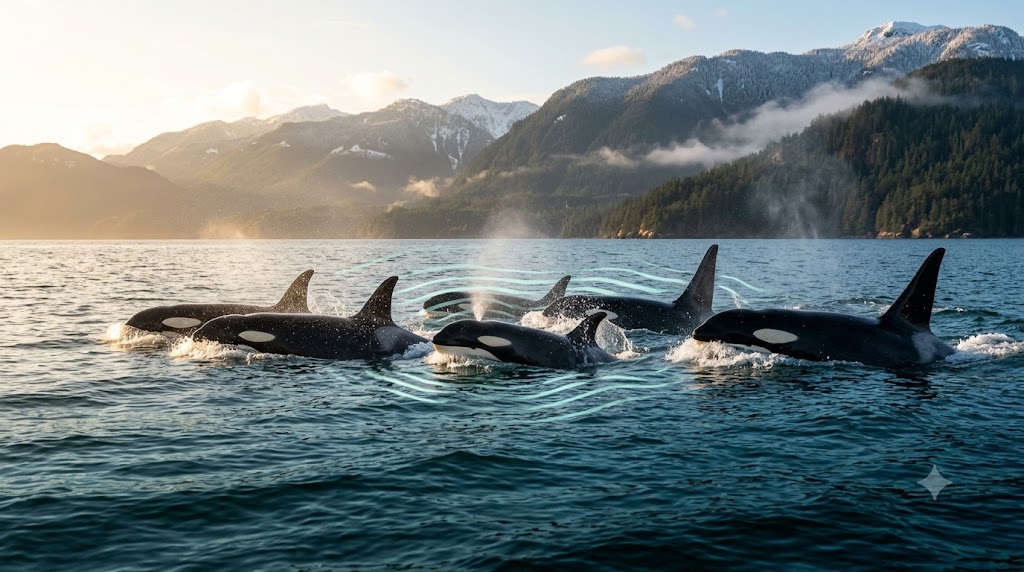
Her reunion wasn’t instant or perfectly smooth — at first she swam off on her own, and early encounters with other orcas were a little rough as she found her place. But within days, something beautiful happened. Springer began traveling steadily with her mother’s closest relatives. Older females in the pod took her under their care, guiding her away from boats and back into the rhythms of orca life.
She had done it. The orphan had come home.
A Happy Ending That Kept Getting Better
The most remarkable part of Springer’s story is that it never stopped being good news.
Year after year, she returned to Johnstone Strait with her family each summer, healthy and thriving. And then came the moment that turned a rescue into a legacy: Springer grew up and became a mother herself. She has had two calves of her own — Spirit, born in 2013, and Storm, born in 2017 — both healthy, both swimming the same waters their mother once nearly died trying to reach.
More than two decades after she was found dying and alone, Springer leads her own little family group, named the A73s in her honor.
Why Springer Matters
To this day, Springer remains the only wild orca ever successfully rescued, rehabilitated, and reunited with her pod. Her story proved something that scientists had only hoped might be true: that when people from different countries, cultures, and backgrounds choose to work with nature instead of against it, even the most impossible rescue can succeed.
A lost, dying baby whale became a thriving mother of two — and a symbol of hope for every endangered orca still swimming the seas.
She found her way home. And she’s still out there today, exactly where she belongs.
