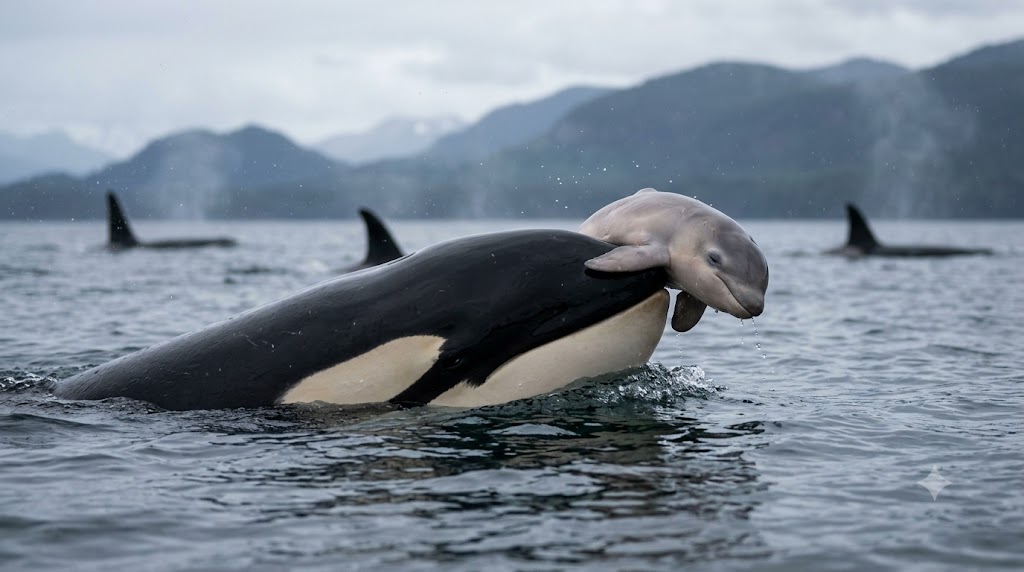
In the summer of 2018, an orca named Tahlequah broke the heart of the entire world. For 17 days, this grieving mother refused to let go of her dead calf — carrying the tiny body more than 1,000 miles through the cold waters of the Pacific Northwest in what scientists came to call a “Tour of Grief.”
It remains one of the most powerful displays of animal mourning ever recorded.
A Birth, and a Loss Within the Hour
Tahlequah — known to researchers as J35 — is a Southern Resident killer whale, part of the critically endangered J pod that lives in the waters off Washington State and British Columbia.
On July 24, 2018, near Victoria, British Columbia, she gave birth to a female calf. It was a moment of rare hope: this population had not produced a surviving calf in three years.
But the joy lasted only minutes. The newborn lived for just half an hour before she died.
What happened next would capture the attention of millions of people around the globe.
Seventeen Days, One Thousand Miles
Tahlequah refused to let her baby sink into the depths.
Instead, she balanced the small body on her rostrum — the front of her head — and began to push it through the water. Every time the calf slipped off, she would dive down, retrieve it, and lift it back up before the waves could carry it away. She did this again and again, hour after hour, day after day.
As the days passed, researchers grew deeply worried. Tahlequah began to look emaciated. Carrying the calf meant she could not hunt properly. According to the Center for Whale Research, her family seemed to share in the grief — and after the seventh day, other members of the pod were seen taking turns helping to float the calf, allowing the exhausted mother to rest.
By the ninth day, the calf’s body had begun to decompose, making it even harder to carry. Still, Tahlequah would not let go.
The pod vanished from view for several days in early August. When they were finally spotted again on August 8, the mother was still carrying her calf — now on the sixteenth day of her vigil.
Finally, after 17 days and roughly 1,000 miles (1,600 kilometers) of swimming, Tahlequah released her baby and rejoined her pod. Remarkably, despite researchers’ fears, she appeared to have survived her ordeal without lasting physical harm.
Why Did She Do It?
Scientists believe Tahlequah’s “Tour of Grief” was an expression of mourning — an emotional response to loss that we usually associate with humans.
Orcas are extraordinarily intelligent animals with some of the strongest social bonds in the entire animal kingdom. Mothers and their offspring stay together for life. Researchers suggest that because the calf had lived, even briefly, and swam alongside her mother, Tahlequah may have formed a bond that made the loss even harder to bear.
Other orcas and dolphins have been seen carrying their dead young before. But what made Tahlequah’s case so extraordinary was the sheer length of time — far beyond the usual day or two that orcas have been observed grieving. Dr. Michael Weiss of the Center for Whale Research put it simply: she was clearly not ready to let go.
A Population on the Brink
Tahlequah’s story is not only one of grief — it is also a warning.
The Southern Resident orcas are one of the most endangered marine mammal populations in the world, with only around 73 individuals remaining. Their survival is tied directly to the Chinook salmon they depend on for food — a fish whose numbers have collapsed due to dams, overfishing, and habitat destruction.
When the salmon disappear, the mothers go hungry. And hungry mothers struggle to carry healthy pregnancies. Researchers estimate that a heartbreaking share of orca pregnancies in this population now end in miscarriage or in calves that die shortly after birth.
Tahlequah’s loss was not just a personal tragedy. It was a symbol of an entire population fighting to survive.
Hope, and Heartbreak Again
There have been brighter days since. In September 2020, Tahlequah gave birth to a healthy male calf named Phoenix (J57) — a name chosen to represent rebirth and hope. He survived, and so did her older son, Notch (J47).
But the sorrow was not over. In late December 2024, Tahlequah gave birth to another calf, a female known as J61. Within a week, that calf, too, had died. And once again — heartbreakingly — the world watched as Tahlequah lifted her baby onto her head and began to carry it through the water, grieving a second time.
A Mother the World Will Never Forget
Tahlequah taught us something we should never have needed teaching: that grief is not uniquely human. That love between a mother and child can run just as deep beneath the waves as it does on land.
She carried her child for 17 days because she was not ready to say goodbye. And in doing so, she made millions of people stop, and feel, and understand — that the ocean is full of hearts as capable of love and loss as our own.
She would not say goodbye. And because of that, the world will never forget her.
