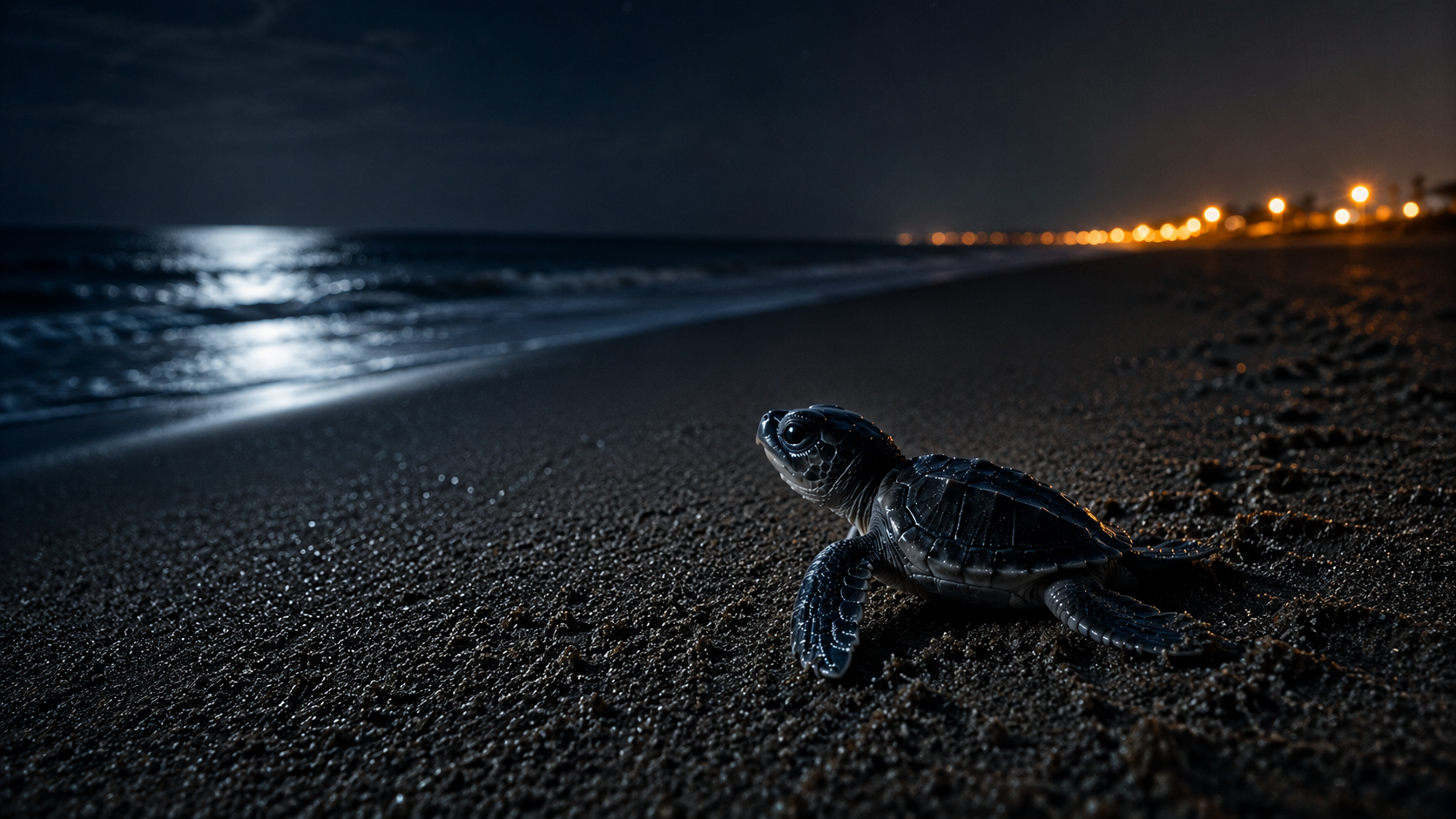
For more than 100 million years, baby sea turtles have found the sea by the light of the moon. Tonight, a single porch light can send them the wrong way — forever.
It happens in the dark, on a quiet beach, in a moment most of us will never see.
A baby sea turtle, no bigger than the palm of your hand, breaks free from its shell beneath the sand. In the blackness, it digs upward alongside dozens of its brothers and sisters, all of them climbing toward the surface together. And then, on tiny flippers that have never touched the world before, it must make the most dangerous journey of its short life: the desperate scramble across the open sand to the safety of the sea.
That walk is only a few dozen meters. For a creature smaller than your hand, it is a marathon — and it is the most important thing she will ever do.
An instinct older than humanity
For more than 100 million years, hatchlings have known exactly which way to go.
They are born with a single, beautiful instinct: crawl toward the brightest, most open horizon. On a natural beach, that brightest point is the ocean — the wide, low shimmer of moonlight and starlight reflecting off the water. The land behind them is dark, tangled with dunes and vegetation. The sea ahead glows softly. So they follow the light, and the light carries them home.
This instinct is older than the human race. It is older than almost anything walking the Earth today. Sea turtles were making this exact journey while dinosaurs still roamed the land. For a hundred million years, it worked perfectly, night after night, generation after generation.
And then, in just the last few decades, we changed the rules.
The night the light moved
Today, that ancient instinct is being turned against them.
A single beachfront light — a porch lamp, a streetlight, a glowing hotel sign — can shine far brighter than the moon. To a newly hatched turtle, that artificial glow becomes the brightest thing on the horizon. And so, trusting the light exactly as her ancestors always have, she turns away from the sea.
She crawls inland. Toward the road. Toward the parking lot. Toward the lights of the town.
Scientists call this disorientation, and its toll is staggering. Researchers estimate that artificial lighting confuses and misdirects hundreds of thousands of hatchlings every single year. In Florida alone, the number lost this way is thought to climb into the tens of thousands annually — and by some estimates, far higher.
Some are exhausted before they ever find water. Some die of dehydration as the sun rises. Some are caught by predators, or never make it across the road. They did everything right. They followed the instinct that had guided their kind for a hundred million years. The world had simply moved the light.
The part that should give us hope
Here is what makes this story different from so many others about wildlife and loss:
The fix is almost unbelievably simple.
Unlike climate change or ocean plastic — vast problems that can leave any one person feeling helpless — this is a problem a single human being can solve in a single moment. By flipping a switch.
There are three things that genuinely save lives:
Turn off unnecessary lights near nesting beaches during hatching season. A dark beach is a safe beach.
Close your curtains and blinds at night if you live or stay near the coast. Even indoor light spilling onto the sand can be enough to send a hatchling the wrong way.
Use turtle-friendly lighting — long-wavelength amber or red bulbs that hatchlings cannot see well. Many coastal towns now require them, and they let people keep the light they need while giving the turtles the darkness they need.
These are not heroic acts. They are small, ordinary choices, made by ordinary people. And together they save thousands of tiny lives every single season.
A small thing to ask
A baby sea turtle asks for so little. Not protection. Not rescue. Just a dark sky and a clear path to the water her ancestors have known for a hundred million years.
Tonight, on a beach somewhere, one of them is making that walk right now — flippers pushing against the sand, eyes searching the horizon for the brightest light, trusting it completely.
The least we can do is make sure that light is still the sea.
If you live near the coast — or know someone who does — share this story. One switched-off light could be the difference between a hatchling reaching the ocean and never making it at all. The smallest action, in this case, is also one of the most powerful.
